Continuous Security Posture &Assurance Management

SEE IT.FIX IT.PROVE IT.

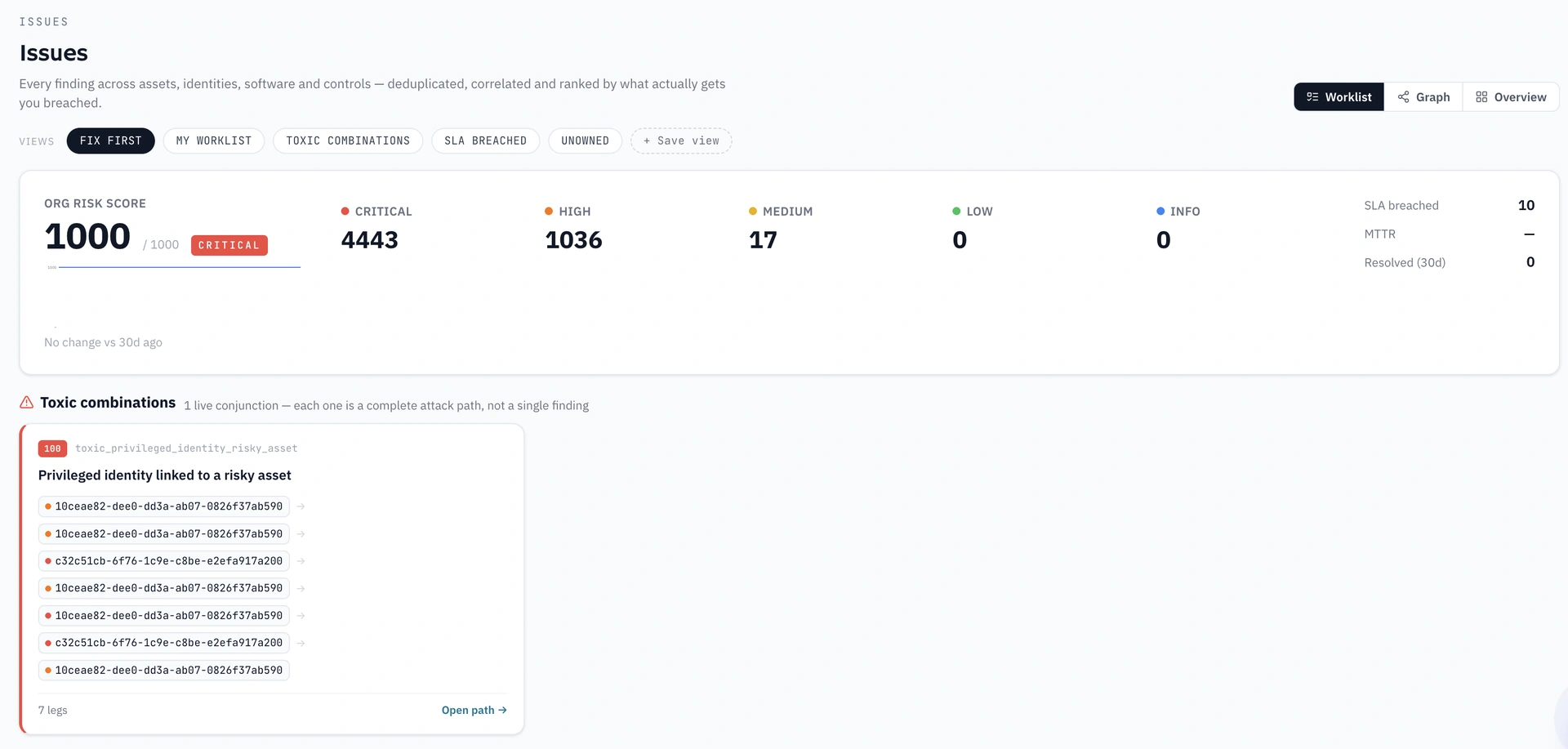
You already have security tools, and you still don’t know which risks matter. CoreGuardian connects the data from those tools: assets, vulnerabilities, configurations, and controls. It shows what puts the business at risk, prioritizes it, checks that your controls are working, tracks each fix to closure, and keeps you audit-ready.

See your organization’s risk.

In one walkthrough, see what matters, who owns it, and what proves it.

See riskRequest a demoSignals to first actionRead-only · No agents · 30+ connectors
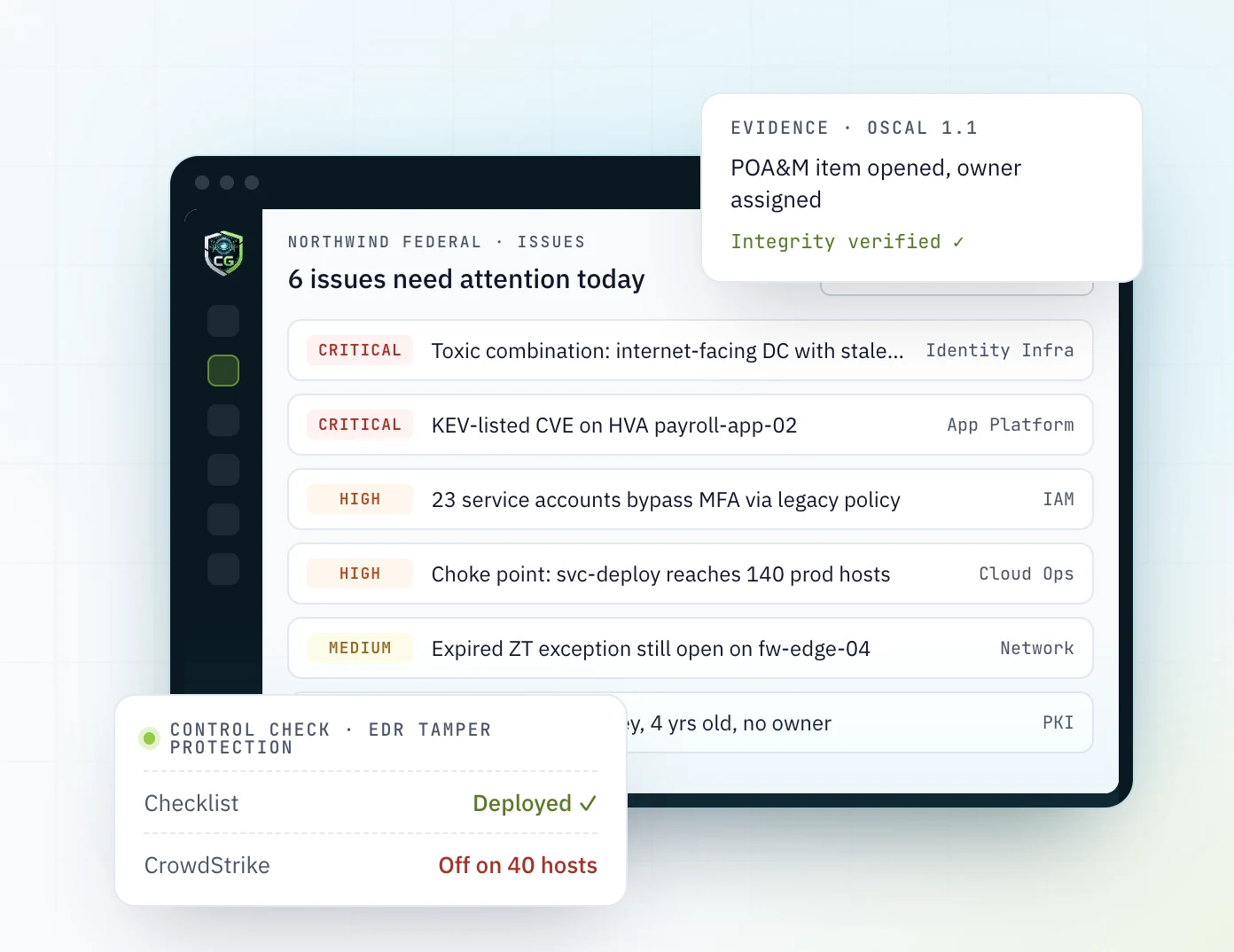
Issues hub with six ranked findings, control-check and OSCAL evidence callouts

Built on the standards your auditors use

  • NIST SP 800-207
  • NIST SP 800-53 Rev 5
  • CISA ZTMM
  • OSCAL
  • CNSA 2.0

What nobody is checking

Deployed isn’t the same as working.

GRC confirms a control was deployed. The SOC watches what fires. Engineering knows what it built. Nobody checks, continuously, that the control is still running, still configured correctly, and still doing its job. Watch both tests run.

Sample runs playing. Click anything to take control.

Is your GRC proving security, or just documenting it?

Most GRC is policy on paper. It tracks whether a control exists, not whether it meets best practice or holds up against zero trust. We test controls against what actually works, and keep testing them.

Controls deployed. This is the audit view.
6of 6
The board asks: is our zero trust posture real?
About two weeks, gathering evidence by hand.
What has your GRC never told you?
Request a GRC gap review

What do you do when you can’t patch?

No patch available. Legacy system. Vendor lock. Compensating controls wrap the vulnerable asset in protection that moves you toward zero trust, without touching the asset itself.

Attacker
Waiting
Segmentation
Not in place
Least privilege
Not in place
Legacy system
No patch available
Exposed
Which systems are you leaving exposed today?
Review my unpatched systems

Both demos use illustrative example data and a simulated legacy system. Your environment will differ.

Product overview

One record, from signal to proof.

Follow an illustrative scenario from connected signal to a ranked, owned issue tracked to closure (POA&M), then captured as tamper-evident evidence.

Connected workflowSignal → priority → proof

Zero Trust Exposure Management, with GRC built in

One platform. Four jobs.

01 · SeeAssets + identity

What’s here?

36

Laptops running a banned app

02 · CheckZero Trust posture

Is it set up right?

14

Laptops with EDR turned off

03 · FixExposure management

What do we fix first?

10

Ranked and assigned this week

04 · ProveGRC

Can we prove it?

4

Records tied to one fix

Each view works from the same record.
The loop follows one connected record from signal through business-context ranking, ownership, closure and tamper-evident evidence.

What nobody is checking

Deployed isn’t the same as working.

GRC checks that a control was deployed. The SOC watches what fires. Engineering knows what it built. Nobody checks, continuously, that the control is still running, still configured correctly, and still doing its job.

That gap is where risk actually lives. It is also why the board question takes two weeks to answer.

The platform

One source of truth. Zero blind spots.

Verify every control, continuously.

  • One reconciled record per asset and identity across 30+ connectors.
  • Cross-tool contradictions surface as findings: Okta says authenticated, CrowdStrike says the agent is stale.
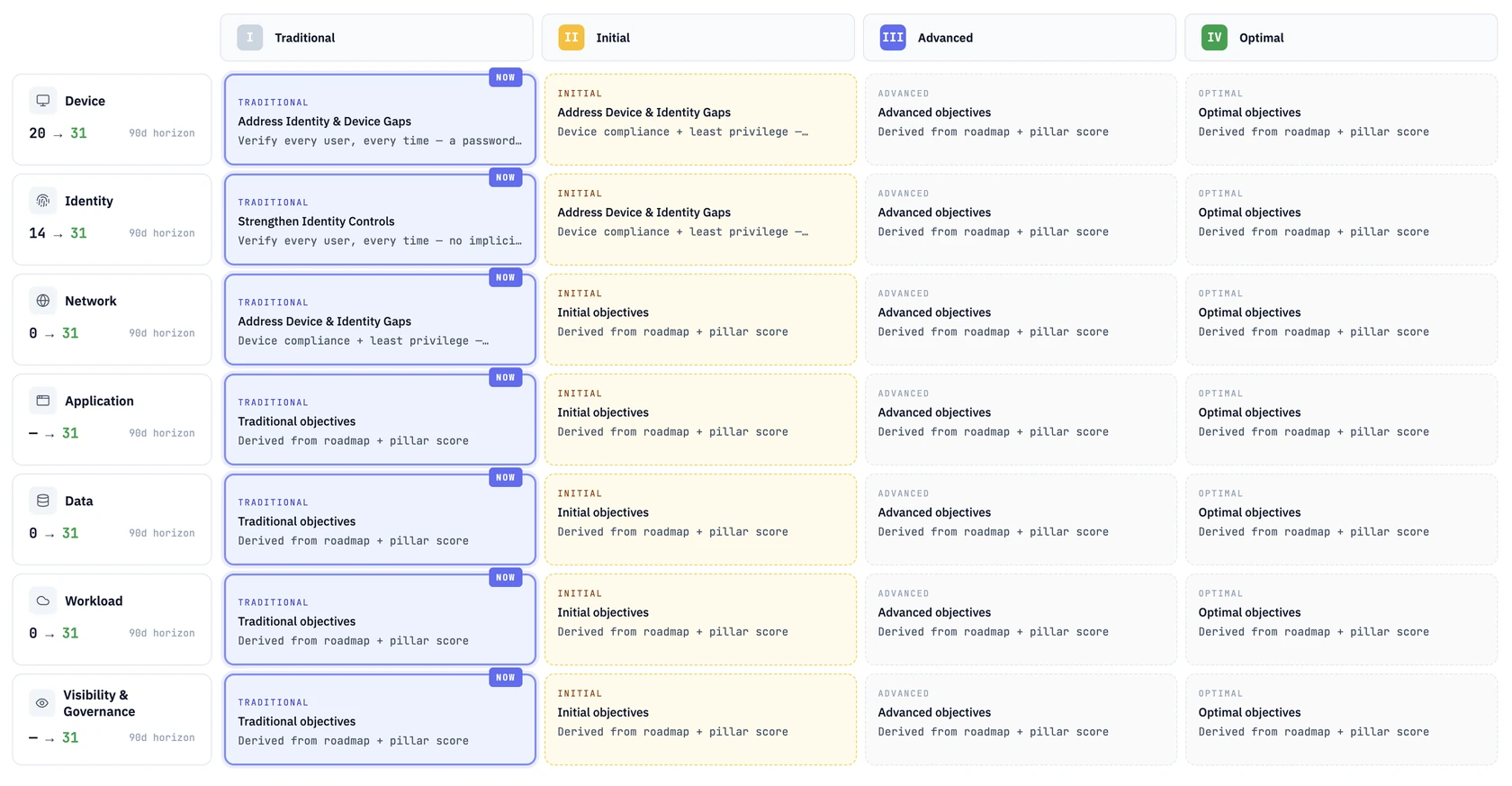
  • Zero Trust maturity per pillar from live connector signal, not a survey.
Zero Trust posture
Zero Trust maturity matrix across CISA ZTMM stages with current pillar posture

How it works

Four steps. Nothing to rip out.

Vulnerability & risk management

Contextual Risk-Weighted Prioritization

Prioritize vulnerabilities based on business risk. The same vulnerability may be urgent on one asset but routine on another, depending on what it protects, how exposed it is, and whether it’s being exploited.

Capabilities

Six jobs, one record underneath.

Pick a job. Watch the same system show up through a different lens. Nothing is copied, reconciled or re-entered between them.

01 / 06

Exposure & Risk Prioritization

A short list, ranked by what the business stands to lose.

Explore Exposure & Risk Prioritization

Where the boundary sits

What we do, and what we don’t.

We’d rather you hear it from us than find it in a demo.

What we do today
  • Read. Read-only connections to 30+ tools. We never need write access.
  • Reconcile. One record per asset and identity, with contradictions raised as findings.
  • Rank. A contextual score and a short, owned list, tracked to closure.
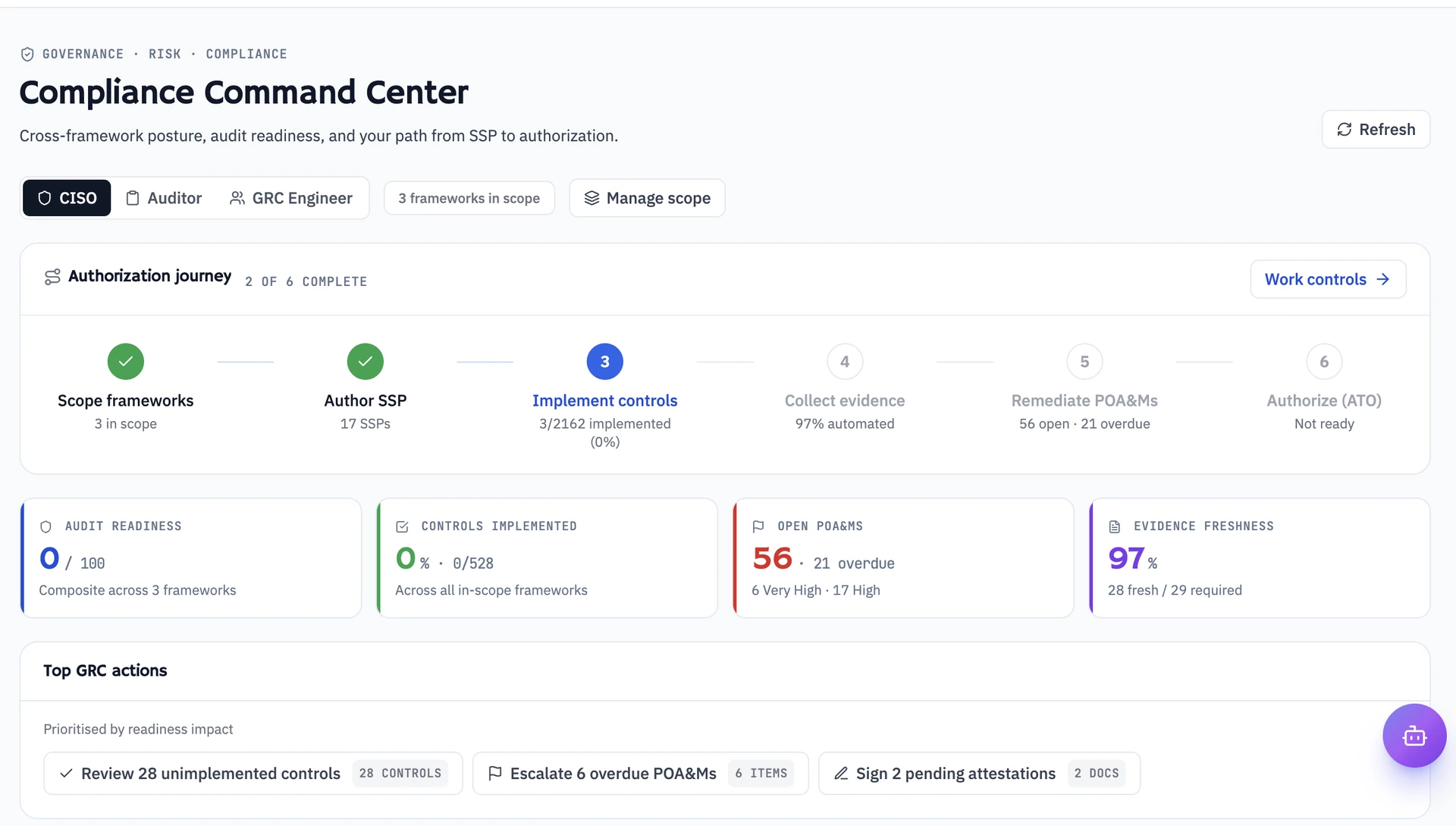
  • Prove. OSCAL SSP, POA&M and framework mappings from the same data.
What we don’t do
  • Change your environment. We never write to your tools. Fixes stay with the teams who own them.
  • Replace your stack. Your scanners, EDR and IdP keep doing their jobs. We verify they are.
  • Promise what isn’t shipped. Ask us about the roadmap in a demo.

Built for practitioners

One record. Four ways in.

CISO

One posture answer

Board-ready evidence, and a case to consolidate budget lines rather than add one.

Security analyst

Dense triage, real owners

Contradictions as findings, toxic combinations and choke points, routed to whoever owns the fix.

ISSO / GRC

The lifecycle, continuous

RMF steps, OSCAL SSP, POA&M and ATO state, fed by live control data.

Assessor

Provenance you can check

Tamper-evident evidence, attributed assertions and time-boxed examiner access.

One source of truth. Zero blind spots.

See what CoreGuardian finds in your environment.

Read-only. No agents. Nothing to rip out.

Request a demo